Consultant, Strategic Policy Advisory
Economic Advisory Council to the Prime Minister · NITI Aayog · New Delhi
Macroeconomic strategy, digital economy, trade policy, global economic developments, and emerging policy priorities.
Professional profile · AM/2026
Economist · policy adviser · author

Abstract
I work on public policy and the digital economy, with experience across macroeconomics, trade, regulatory strategy, technology adoption, and MSME competitiveness.
I am a Senior Consultant with the Centre for Effective Governance of Indian States (CEGIS), on its Jobs, Productivity, Employment and Growth team. Until September 2026 I served in the Office of the Vice Chairman at NITI Aayog. My earlier work spans research, development institutions, and investment advisory.
Curriculum vitae
Economic Advisory Council to the Prime Minister · NITI Aayog · New Delhi
Macroeconomic strategy, digital economy, trade policy, global economic developments, and emerging policy priorities.
LEAD at Krea University · New Delhi
Digital economy transformation, MSME competitiveness, platform-enabled livelihoods, and technology adoption.
National Data Innovation Centre, NCAER · New Delhi
Nationally representative panel studies, reproducible research systems, statistical analysis, and socioeconomic policy research.
Oxus Investments · New Delhi
Political economy, macroeconomic, and regulatory analysis for international investor and institutional clients.
Consultancy engagements
Education & fellowship
Publication
Juggernaut Books · 2024 · ISBN 9789353458430
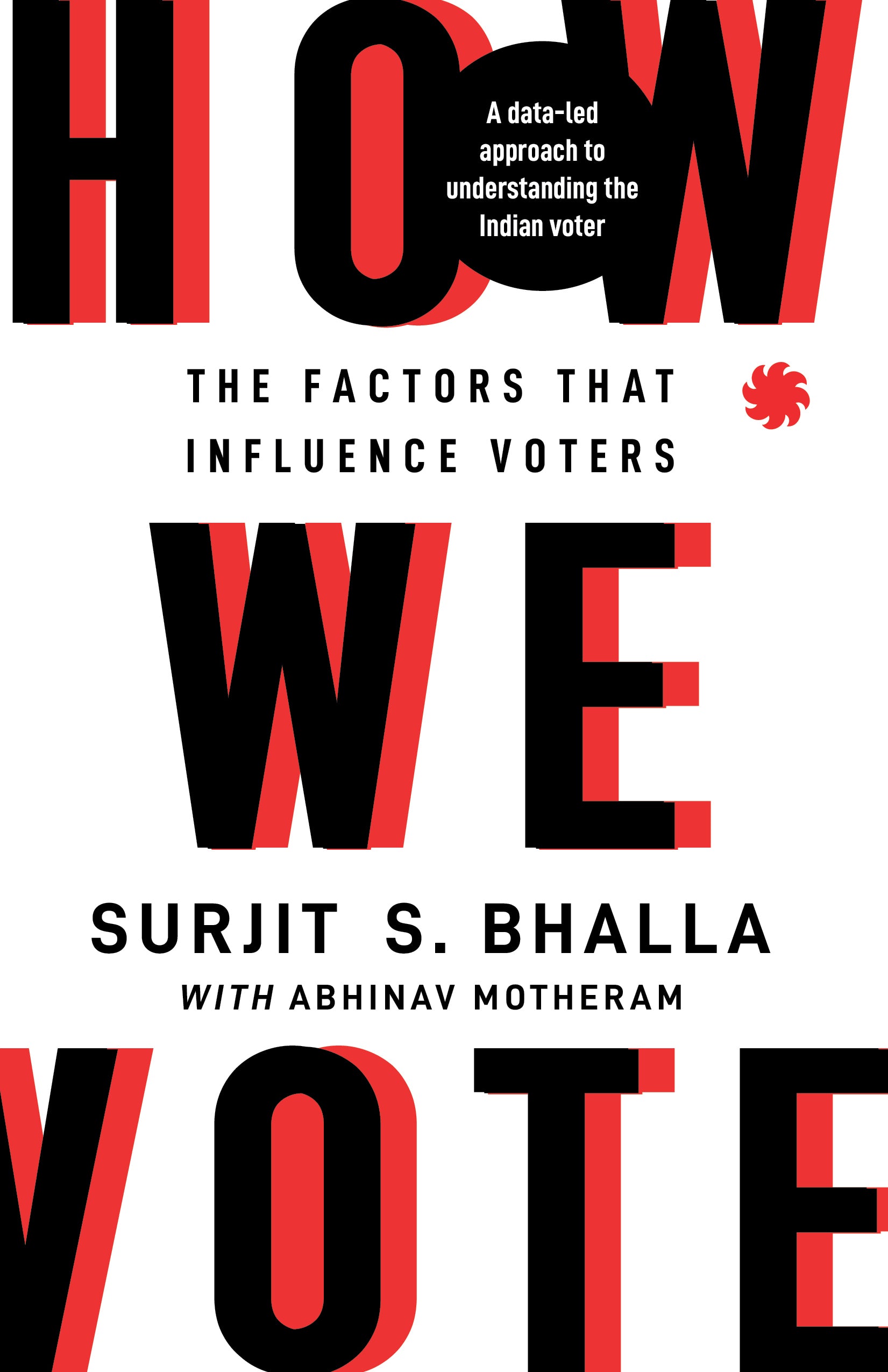
Bhalla, Surjit S., with Abhinav Motheram. How We Vote: The Factors That Influence Voters. New Delhi: Juggernaut, 2024.
A data-led study of Indian voting patterns: how voter choice relates to income, employment, welfare schemes, gender equality and changing political attitudes, and what delimitation may mean for future elections.
Selected writing
Digital payments, economics, elections, institutions, and the changing global order.
Keep UPI free for consumers and small merchants, while allowing a capped merchant discount rate for larger commercial users and higher-value transactions.
The Indian Express · Opinion · 26 August 2026With Sharon Buteau. A non-technical summary of our district-level study of UPI adoption.
Ideas for India · 3 August 2026With Suman Bery and Bhaskar J Kashap. Finding opportunities in global rebalancing.
Business Standard · Opinion · 30 April 2026With Sharon Buteau. Peer-reviewed article on how merchant acceptance and connectivity shape digital payment adoption across Indian districts.
Discover Sustainability 7, 560 · Springer · 10 April 2026Soutik Biswas’s report features the Motheram–Buteau research on merchant acceptance and quotes Abhinav Motheram.
BBC News · 16 August 2026A dispatch from the dying embers of the old order: tariffs, dollar power, stablecoins and system transition.
1 April 2025 · Economics · Geopolitics · United StatesVoice, exit and loyalty amid platform controversy, USAID upheaval and self-censorship.
14 February 2025 · Political Economy · Ideas · MediaTurnout, urban disengagement and Delhi’s peripheral political shift on results morning.
8 February 2025 · Delhi · Elections · TurnoutStatistics, ground truths and heavenly lies after Ann Selzer’s final Iowa poll.
17 January 2025 · Polling · Elections · United StatesThese essays were first published in 2025 and are preserved in their original form. Claims and links reflect the publication date; canonical sources are maintained in Quarto Markdown or Org mode.
Research agenda
Policy questions at the intersection of technology, firms, political economy, and institutions.
How do digital public infrastructure and platform markets change MSME productivity and formalisation?
Which policy frictions determine whether smaller firms adopt and benefit from new technologies?
How are trade, monetary change, and industrial strategy reshaping India’s external economy?
What can electoral data reveal about welfare, turnout, voter choice, and institutional trust?
Correspondence
Research, consulting, speaking, and collaboration enquiries.
New Delhi, India