It’s election results morning in Delhi, and the city holds its breath. Politicians, analysts, and voters alike are eagerly waiting to see how the numbers unfold. The stakes are high, and while there’s no massive electoral "wave" being predicted, early signs suggest that turnout trends will play a key role in determining today’s winner.
Before diving into Delhi, let’s take a quick detour to Iowa, where our previous analysis just got an unexpected update. In a special election for Senate District 35, Democrats flipped the seat from Republican Chris Cournoyer despite Iowa being part of Trump’s 2024 sweep. Des Moines Register Report
Sure, it’s just one seat, but it's a symbolic shift. It seems Ann Selzer wasn’t entirely wrong in predicting some Democratic strength last November—she was just early. On a more serious note, this victory once again underscores a larger pattern of voter disenchantment with incumbents across party lines, a trend we’ve seen repeatedly in elections from India to the US.
This brings us back to Delhi, where similar themes of anti-incumbency, urban fatigue, and suburban mobilisation may be playing out. Let’s look at what the turnout data reveals.
Turnout Trends and the Peripheral Shift
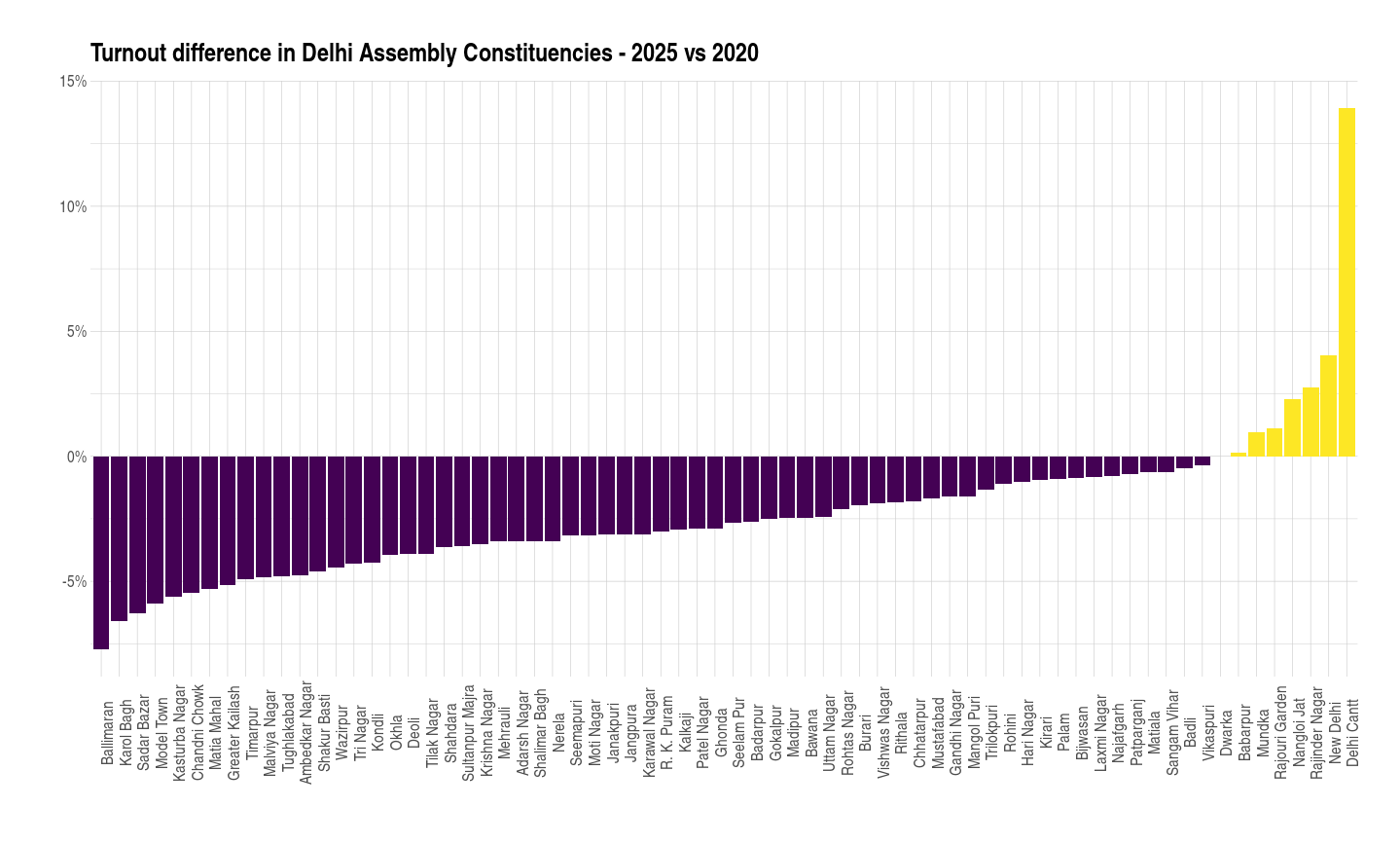
Across much of Delhi, turnout has declined in core urban constituencies. Ballimaran, Karol Bagh, and Timarpur - once strongholds for AAP - have seen 5 to 8 percentage point drops in turnout. This mirrors what we saw in Iowa’s Polk County, where urban voters disengaged in the face of stagnating local issues. It’s a familiar sign: urban fatigue, where long-time supporters stay home instead of turning out for the incumbent.
Meanwhile, the peripheral constituencies around Delhi are telling a different story. In Delhi Cantt, turnout surged by 13 percentage points, and this constituency has also seen increased NFSA enrollment, indicating a shift in the demographics and political salience of national welfare programs. A Hindustan Times analysis highlights how outer areas are becoming more politically influential, driven by population growth and evolving demands for infrastructure and services.
Further complicating matters is the Purvanchali vote, which has gained strength in both core and semi-urban districts, as noted in this report. If BJP has successfully mobilized these newer voters in semi-peripheral areas, AAP may face tougher contests in constituencies it previously considered safe.
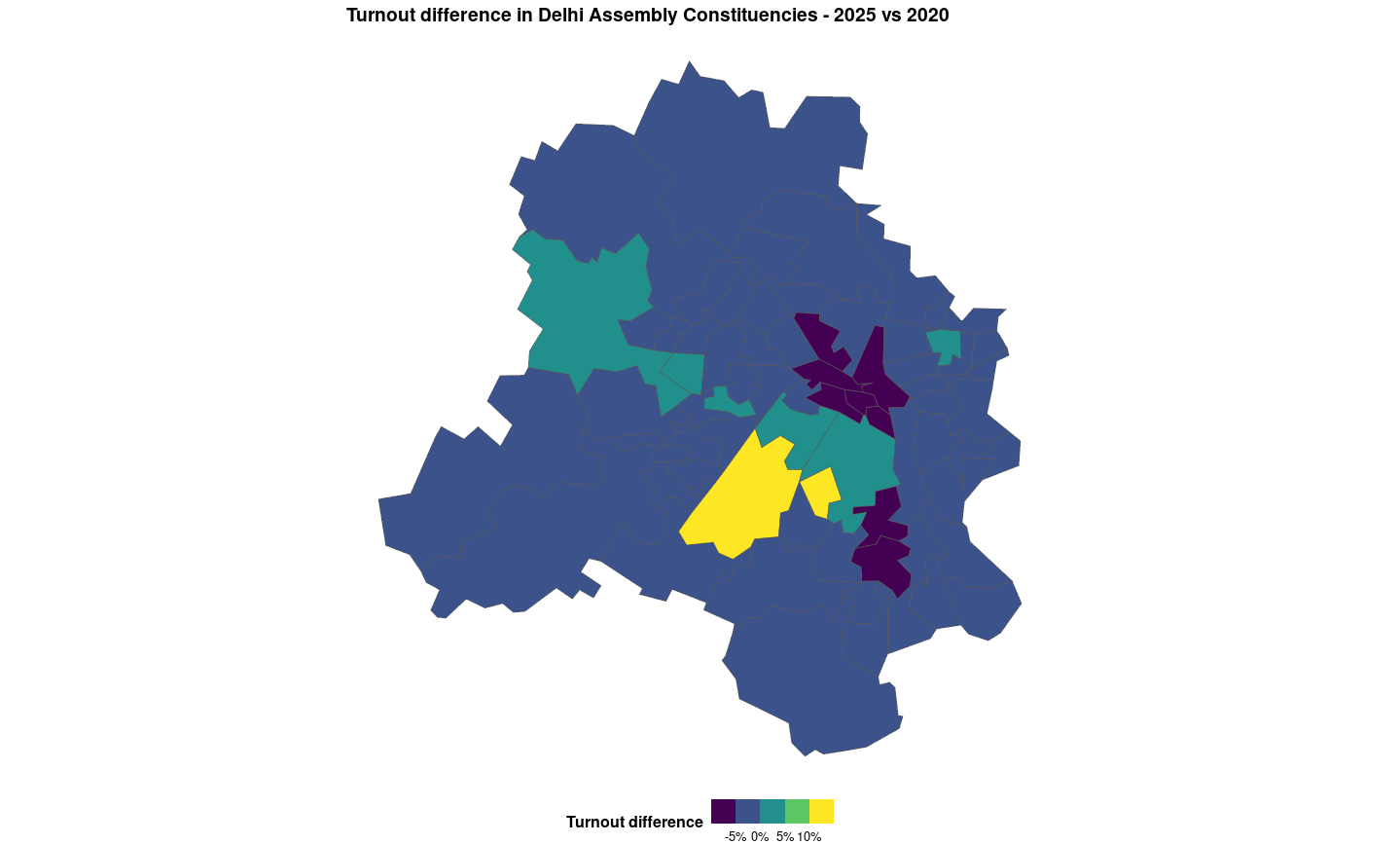
Urban Disillusionment vs. Suburban Momentum
This election may hinge on urban disengagement vs. suburban mobilization - just like what we saw in Iowa’s suburbs, where places like Dallas County showed stronger voter engagement than the urban centers. In Delhi, outer constituencies like Nangloi Jat and Chhatarpur are seeing shifts in political attention as well. While AAP’s welfare programs still resonate in some areas, BJP appears to be pushing a development-focused narrative - roads, housing, and infrastructure - where AAP's messaging may not hold as much sway.
Meanwhile, New Delhi constituency, where Arvind Kejriwal himself is running, has seen an increased turnout of 4 percentage points. Normally, this would indicate strong support, but with Amit Shah leading BJP’s campaign blitz here, it could reflect opposition mobilization. Kejriwal might still win, but with a reduced margin that would send a signal of anti-incumbency creeping into even AAP’s leadership strongholds.
Anti-Incumbency in Play
Globally, we’ve seen anti-incumbency sentiment disrupt political landscapes, whether it’s Trump’s resurgence in 2024, Modi’s challenges in India, or Europe’s populist victories. Delhi is no exception. AAP, which once rode to power as an anti-establishment movement, is now facing discontent in both urban and semi-urban areas.
Projections: What Could Happen?
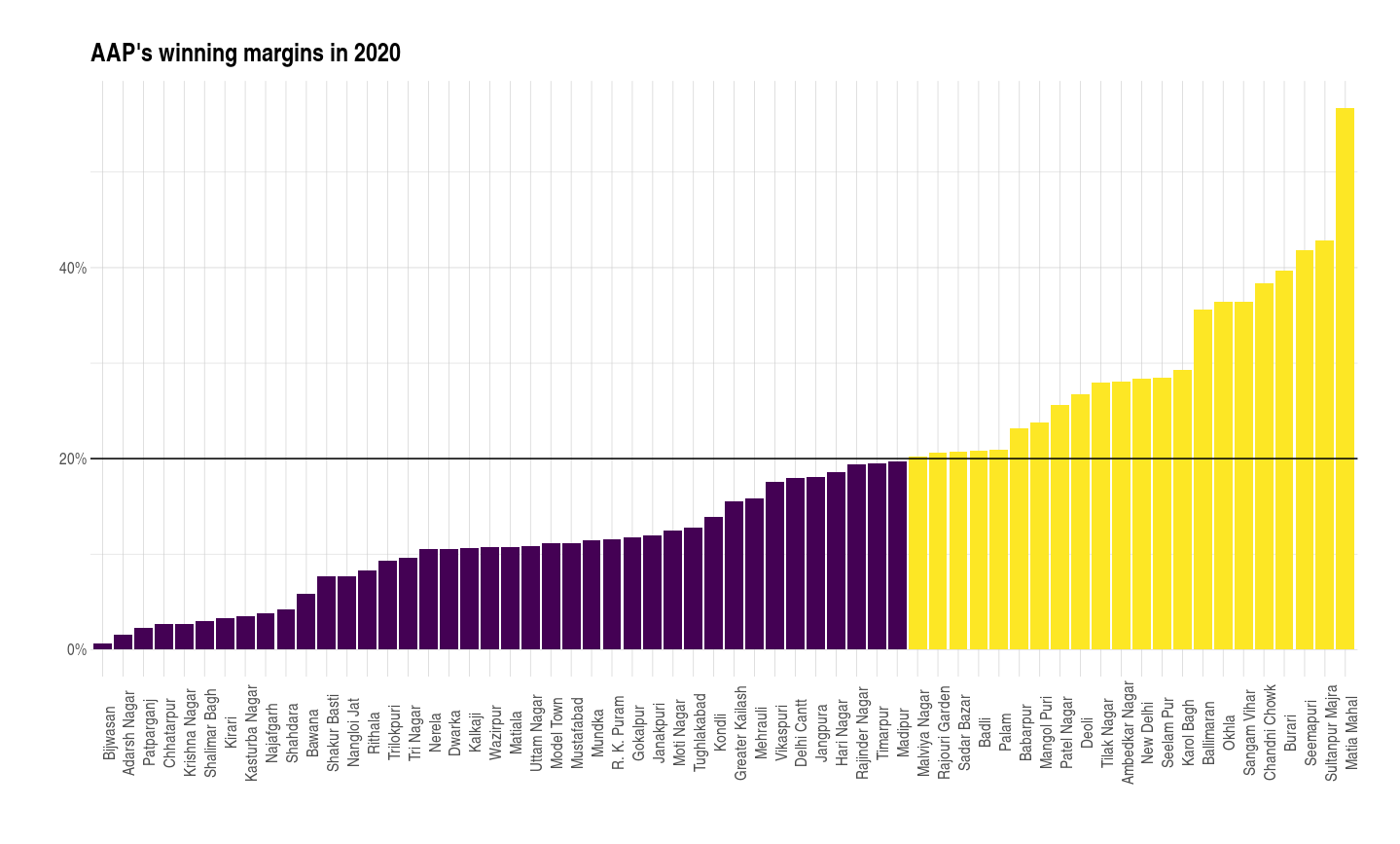
In the 2020 Delhi Assembly elections, AAP's dominance was evident across a majority of constituencies, with several seats won by large margins. As seen in the chart, AAP secured margins exceeding 20% in at least 22 constituencies, making these areas relatively "safe seats." These constituencies—such as Matia Mahal, Seemapuri, and Chandni Chowk—represented core areas of support where voter turnout and allegiance to AAP's governance and welfare programs were strong. In these seats, BJP and Congress struggled to make inroads despite aggressive campaigns.
However, at the lower end of the spectrum, there were marginal victories in constituencies like Bijwasan, Adarsh Nagar, and Palam, where AAP's lead was under 5%. These areas are more susceptible to swings in voter sentiment or changes in turnout dynamics. Constituencies with narrow margins are crucial battlegrounds in 2025, especially given the trends of lower voter turnout and possible anti-incumbency sentiment. If BJP capitalizes on these vulnerabilities with effective mobilization efforts, the balance of power could shift significantly, even in previously AAP-held areas. Ultimately, the safe seats will likely hold, but the fate of AAP's thinner-margin constituencies may decide the overall outcome.
Based on back-of-the-envelope calculations, designed to explore potential outcomes rather than provide definitive predictions, the projected seats . These assumptions were shaped by the anti-incumbency sentiment highlighted in exit polls and patterns we've observed in elections worldwide. The key starting point is the decline in voter turnout across many constituencies, particularly in urban strongholds where AAP has historically done well. Our assumption is that much of this turnout drop likely comes from disengaged AAP supporters - a common phenomenon in elections where incumbents face fatigue among their base.
Applying swing scenarios of 5%, 10%, and 15% against AAP to simulate varying degrees of voter defection, here’s how things might shake out. While these numbers are by no means exact forecasts, they provide a useful range of possibilities. Under these assumptions, AAP's seat count could decline significantly, turning previously tight-margin constituencies into battlegrounds and potentially giving BJP a path to a majority.
| Swing against AAP | AAP seats | BJP seats |
|---|---|---|
| 0% (Baseline) | 51 | 19 |
| 5% Swing | 38 | 32 |
| 10% Swing | 29 | 41 |
| 15% Swing | 22 | 48 |
A 5% swing against AAP, combined with lower turnout, could result in a close contest. If the swing rises to 10-15%, which is not improbable given the current global political landscape and Delhi voters’ penchant for swinging one way or another, BJP may even secure a majority and maybe a bit more to spare, upending the political landscape!
What to watch out for?
As results start to roll in, here’s what to watch for:
Will AAP retain enough of its urban base despite lower turnout?
Can BJP’s push combined with Congress’ third wheel in peripheral constituencies like Delhi Cantt convert these turnout increases into actual seat wins?
How will swing constituencies like New Delhi and Chhatarpur reflect broader anti-incumbency trends?
One thing’s for sure: Delhi's turnout trends are more than just numbers - they're hinting at a story of political change. Stay tuned.